
The thickness of galvanized steel sheet refers to the thickness of the base metal (substrate), excluding the thickness of the surface zinc layer. There are several ways to express this thickness; some regions commonly use “gauge” (abbreviated as GA), while others use metric units (mm). Both methods are widely used in the field of metal sheets such as galvanized steel and stainless steel.
| American Standard Gauge (Thickness Number) | Base Material Thickness (mm) | Base Material Thickness (inch) | Application Scenarios |
| 14Ga | 1.905 | 0.075″ | Preferred for high-load-bearing scenarios, with excellent strength |
| 16Ga | 1.524 | 0.060″ | Balances strength and cost-effectiveness, the most widely used |
| 18Ga | 1.214 | 0.0478″ | General-purpose specification for conventional civilian and industrial use |
| 20Ga | 0.889 | 0.035″ | Mainstream specification in the construction field, with extremely high cost-performance |
| 22Ga | 0.711 | 0.028″ | Preferred for lightweight requirements, easy to process and bend |
| 24Ga | 0.559 | 0.022″ | Thin sheet, suitable for precision components |
| 26Ga | 0.457 | 0.018″ | Ultra-thin and light, only suitable for low-load scenarios |
| 28Ga | 0.376 | 0.0148″ | Extremely thin, should avoid load-bearing applications |
| 30Ga | 0.305 | 0.012″ | A niche specification that requires custom production |
| 32# (Industry-Specific Specification) | 0.34 | 0.0134″ | Non-standard Gauge |
- Gauge (Ga.): A traditional unit of thickness; a higher number indicates a thinner material.
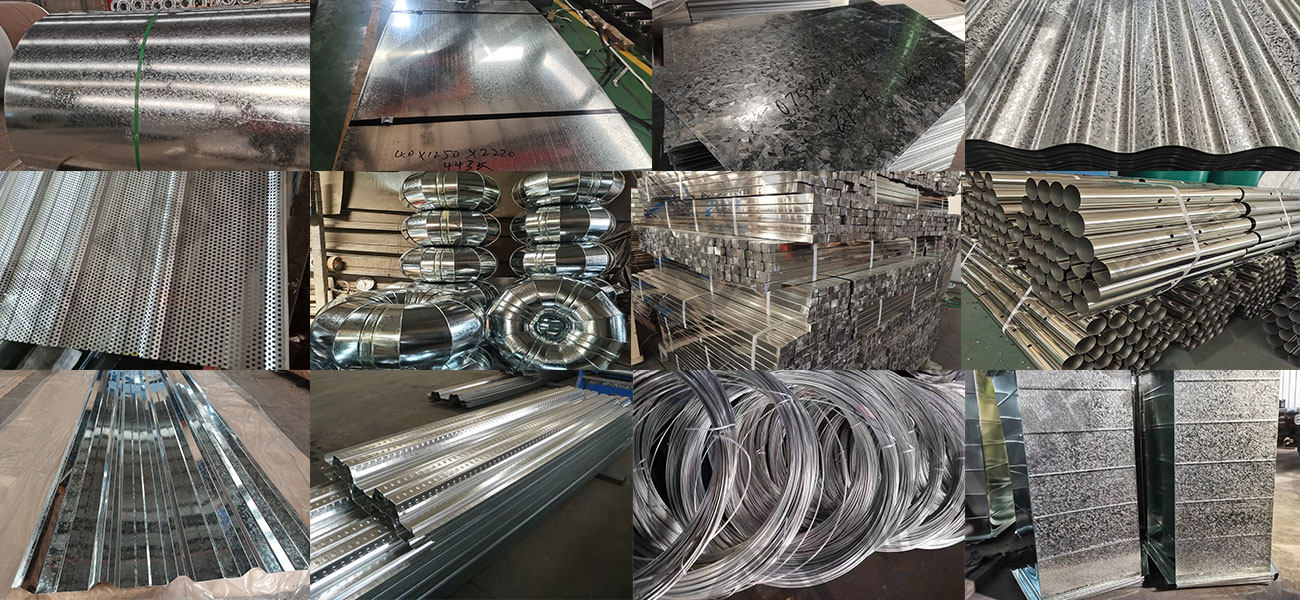
As a professional galvanized steel supplier, Wanzhi Group offers a full range of GI sheet products, providing precise and high-quality material solutions to global customers, perfectly matching the above gauge and millimeter conversion specifications. Leave us a message to tell us the galvanized steel specifications you need and get a free quote!